Shamva- They arrived in different waves of school uniforms, their voices rising above the red dust like a promise.
Five hundred girls.
Then the whistle blew, and for a few hours, the only thing that mattered was the ball, the goal, and the fierce, unbroken spirit of a generation refusing to be defined by tradition or circumstance.
This was not just a netball tournament. It was the birth of a movement and at its heart, a quiet, determined organiser who sees in these young athletes the living embodiment of the Second Republic’s promise.
In a powerful reincarnation of the Netball World Cup spirit, 20 elite players from Shamva North and South battled on the court on Saturday.
But the true story unfolded on the sidelines, where over 500 young girls, some as young as 15, gathered for counselling, mentorship and a message that resonated far beyond the pitch.
They are the new generation for President Emmerson Mnangagwa’s Vision 2030, and they will not be left behind.
Nyati mine owner Mr Sam Paul, affectionately known as Boss Sam the event organiser, stood at the centre of the whirlwind, his eyes fixed not on the scoreboard but on the sea of young faces that surrounded the court.
For him, this tournament is the beginning of something much larger.
“What you are seeing today is the emergence of a new generation of young girls for ED, girls who are empowered, educated and equipped to say no to child marriage and substance abuse,” said Mr Paul, his voice carrying both pride and urgency.
“But this cannot be a one-day event. We are already in discussions with relevant authorities and local stakeholders to take this model nationwide.
“We want every district in Zimbabwe to have its own ‘World Cup’ a platform where sport becomes the shield that protects our girls,” said Mr Paul.
Mr Paul’s vision aligns seamlessly with the National Development Strategy 2 (NDS 2), which prioritises social protection, gender equality and human capital development. But he is the first to admit that achieving scale requires partnership.
“Government cannot do it alone. The private sector, traditional leaders, schools, we all have a role to play.
“I have already approached the relevant authorities with a proposal. The response has been encouraging. They see what I see, a replicable, low-cost, high-impact intervention that delivers results on the ground. These 500 girls are our proof of concept,” he said.
For the traditional and educational leaders present, the tournament represented a rare alignment of community effort, national policy and grassroots empowerment.
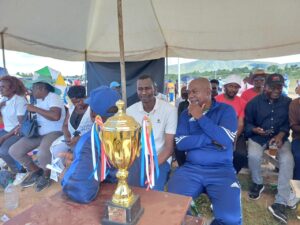
Village Head, Sekuru Chiyangwa, watched the proceedings with the quiet satisfaction of a man who has seen too many young lives derailed.
“In the past, we lost our girls to early marriages because we gave them no reason to hope. Today, I see hope in their eyes. They are running, they are cheering, they are learning.
This is the new generation for young girls 4ED, a generation that will take Zimbabwe forward.
“I am calling on all village heads in this province to support this initiative. Let us make Shamva the example that the rest of the country follows.”
Teachers present noted that the presence of stakeholders signals a shift from isolated community efforts to coordinated state-civil society collaboration.
“As educators, we see the scars of child marriage every day, the empty desks, the dreams cut short.
“What Mr. Paul has done here is create a vehicle that we can all rally behind.
“But for this to sustain, we need the Ministry to recognise this as a flagship programme. We need resources, we need policy support, and we need to make this part of the school sports calendar nationwide. These 500 girls are proof that when we invest in them, they deliver,” said a teacher from Jiti high school.
The tournament’s evolution from a competitive match between 20 elite players to a mass gathering of 500 girls for counselling and mentorship was, by all accounts, organic. Word spread through villages, then through schools.
By morning, buses had deposited hundreds of girls at Jiti high school pitch, all of them eager to listen for a message of empowerment.
Mrs. Gladys Murewa, a sports instructor from Shamva South, moved through the crowd like a general among her troops, her voice a steady anchor.
“I have been teaching netball for fifteen years. I have never seen anything like this. “These girls came here today as individuals. They are leaving as a sisterhood. They know now that they are not alone, that there are teachers, traditional leaders, government departments, and people like Mr. Banda who are fighting for them. That knowledge is more powerful than any trophy.”
The counselling sessions, she explained, were the day’s quiet triumph. Social workers led frank discussions on resisting coercion, understanding legal rights, and recognizing the dangers of substance abuse. Peer educators shared personal testimonies. For many girls, it was the first time they had been told, explicitly and unequivocally, that their bodies, their futures, and their choices belonged to them.
As the sun dipped below the horizon and Chindunduma high school hoisted the trophy, Mr Paul was already looking ahead.
“This is not the end. This is day one,” he said, watching the 500 girls disperse back to their villages, their voices still carrying the day’s energy. “I am going to knock on every door government, corporate, traditional, until this becomes a national programme. Vision 2030 is about leaving no one behind. Today, we made sure that 500 girls know they are not behind. They are leading the way.”
For the new generation of young girls for ED, the journey has begun. And if the dust of Shamva has anything to say about it, they will not be the last.